END-GRAIN GUIDES
Nakiri vs. Santoku for Vegetables: Which Knife Should You Choose?
nakiri vs santoku for vegetables: Compare cutting styles and trade-offs to choose the right kitchen knife.
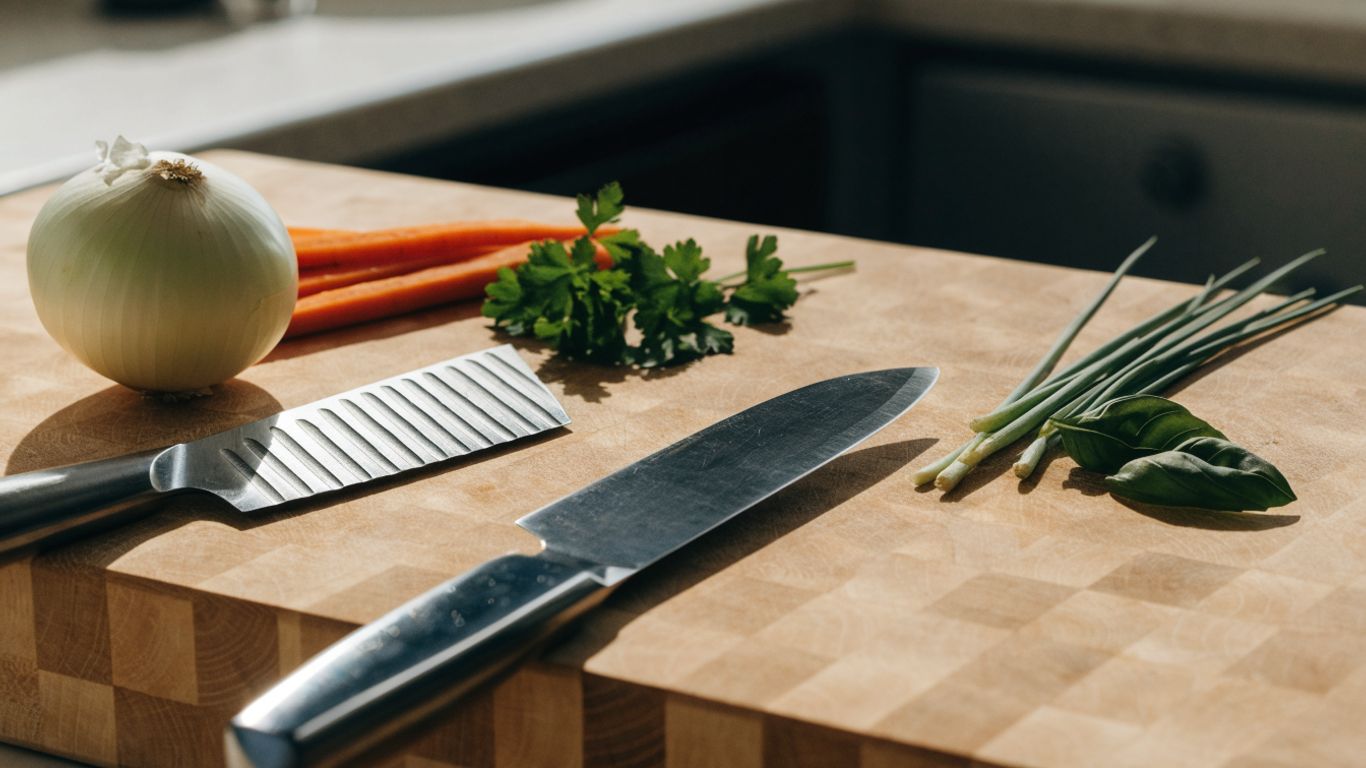
The short answer
For vegetable-heavy cooking, a nakiri’s straight edge makes board-contact chopping feel natural; a santoku is the more flexible choice if your prep includes meat and fish too. Choose by the motion and mix of ingredients you use most, not by the knife’s name alone.
- A nakiri has a tall, rectangular blade and a mostly straight edge suited to chopping vegetables.
- A santoku usually has a more curved edge and a tip that offers more flexibility for varied prep.
- Either knife can handle everyday vegetables; the cutting motion is the practical difference.
- For meat and fish, a santoku is generally more useful, while a nakiri is specialized for produce.
- Blade length, handle comfort, and safe care matter as much as the style of knife.
How do nakiri and santoku knives differ?
A nakiri is designed around vegetable prep, while a santoku covers a broader range of everyday cutting. Their blade shapes influence how they meet the board and how you move through ingredients, though exact profiles vary by maker. The differences are useful, but neither shape makes good technique optional.
Blade shape and edge profile
A nakiri typically has a broad, rectangular blade with a straight cutting edge. A santoku’s edge often has a gentle curve, so the two knives naturally suit different motions: the nakiri favors a direct downward or push cut, while the santoku can also rock slightly through an ingredient. The edge profile guides your stroke, but it does not dictate a single correct technique.
| Feature | Nakiri | Santoku |
|---|---|---|
| Main focus | Vegetable preparation | General kitchen prep |
| Edge profile | Mostly straight | Usually gently curved |
| Tip shape | Blunt or squared-off | Rounded or sheepsfoot-style |
| Common motion | Push cut or chop | Push cut, chop, or light rocking |
Those are common patterns rather than guarantees; individual knives differ. If you can, hold the knife and look along its edge before deciding which shape fits your usual stroke.
Blade height and knuckle clearance
Both knives often have a taller blade than a narrow utility knife, giving your knuckles room above the board during a comfortable pinch grip. A tall blade can also help you guide a cut and move chopped vegetables with the broad side. The precise clearance depends on the knife’s dimensions and your grip, so a familiar cutting board is a useful place to test the feel.
Tip design and what it’s useful for
A nakiri’s squared or blunt tip is not meant for piercing tasks; its shape keeps the blade’s focus on chopping and slicing produce. Many santoku knives have a rounded, sheepsfoot-style tip, which can help with small detail cuts but is not as pointed as a typical chef’s knife. If you often pierce a tomato skin or trim around a small detail, consider whether a more defined point is useful in your kitchen.
Typical blade length and weight
Santoku and nakiri knives are commonly sold in a compact, home-kitchen-friendly range, but there is no single standard length or weight across all makers. A heavier blade may feel steady during repeated chopping, while a lighter one may feel easier to reposition. Check the actual measurements and balance rather than assuming that two knives with the same name will feel alike.
How does each knife cut vegetables?
Both knives can slice, dice, and chop vegetables cleanly when they are sharp and used with control. The nakiri’s straight edge makes full board contact straightforward, while the santoku’s curve gives you more freedom to rock the blade. Your preference may come down to whether you want a dedicated chopping feel or a knife that adapts to several strokes.
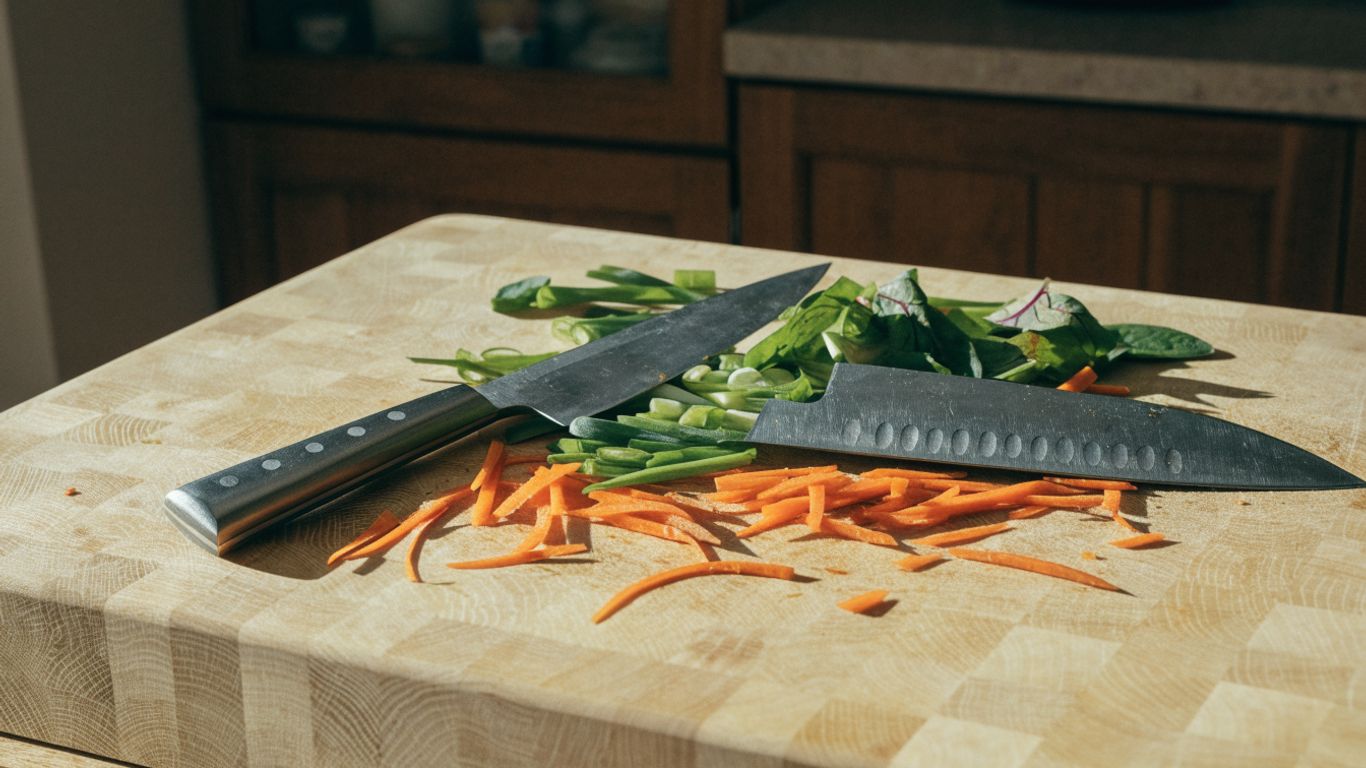
Nakiri’s straight edge for clean, full-length cuts
With a nakiri, a downward chop or forward push can bring much of the edge into contact with the board at once. That can be handy for slicing a row of scallions or cutting through a stack of greens without leaving a narrow hinge at the bottom. Keep the blade moving in a controlled line; forcing it through a hard ingredient is not a substitute for a sharp edge.
Santoku’s curved edge for rocking and push cuts
The santoku’s curve makes a small rocking motion possible, though many cooks use it with a push cut instead. That flexibility can be convenient if you switch between chopping, slicing, and mincing during the same prep. The motion should stay comfortable and controlled rather than turning into a large, fast rocking swing.
Chopping herbs, dicing onions, and slicing greens
A nakiri works naturally for repeated straight-down cuts through herbs, onion layers, and leafy vegetables. A santoku handles the same jobs, with an edge profile that may suit you better if you mince with a short rocking action. For more even onion pieces, first make stable cuts and keep the ingredient from shifting; this uniform vegetable dice method walks through a careful sequence.
How blade shape affects food sticking
Wet or starchy slices can cling to either knife. A broad blade may make it easier to lift or guide chopped food, but blade finish, thickness, and surface features also affect how ingredients release. Treat sticking as a small nuisance, not a reliable test of knife quality: pause to clear the blade safely rather than shaking it near your fingers.
Which knife suits common prep tasks?
Choose a nakiri if most of your knife time is spent preparing vegetables and you prefer direct chopping. Choose a santoku if you want one compact knife for vegetables plus occasional meat or fish prep. For either option, match the knife to the foods you cut and the space you have, rather than buying for a rare task.
Choose a nakiri for high-volume vegetable prep
If you regularly cut cabbage, greens, carrots, or piles of other produce, a nakiri’s straight edge can make repeated board-contact cuts feel simple. It is particularly appealing when your preferred motion is a push cut or a straight chop. The trade-off is specialization: its blunt tip and flat edge are less suited to piercing or broad all-purpose work.
Choose a santoku for mixed ingredients
A santoku is a sensible choice when vegetable prep shares the board with boneless meat or fish. Its edge shape and tip generally give you more options than a nakiri, without requiring a long chef’s knife. A practical sequence can help keep ingredients organized:
- Set out a stable board and gather the ingredients before cutting.
- Prepare vegetables with the motion that feels controlled for you.
- Clean the work area and use a clean surface before moving to raw meat or fish.
- Wash the knife and board after handling raw ingredients.
This sequence keeps the work orderly without asking one blade to do every job. A santoku is versatile, but it is not designed for every cutting task.
Handling dense vegetables such as squash and carrots
A sharp knife and a stable ingredient matter more than choosing between these two names. For a dense vegetable, first create a flat side so it cannot roll, then cut with steady pressure and keep your free hand clear of the blade’s path. Avoid twisting a knife that has become stuck; reposition the ingredient or choose a tool suited to the task.
Where neither knife is the right tool
Neither is the right choice for cutting through bones or doing heavy cleaver work. A nakiri’s vegetable-focused tip is also a poor fit for jobs that depend on piercing, while a santoku’s point is still less pronounced than that of many chef’s knives. Keep a separate tool for specialized work instead of putting unnecessary force on a kitchen knife.
How versatile is each knife beyond vegetables?
A santoku is generally the more adaptable of these two knives for a mixed menu, while a nakiri stays focused on vegetables. That distinction matters if you want one primary knife, but it does not mean every cook needs both. If you are comparing the two designs in more detail, this Santoku and Nakiri comparison guide offers another perspective.
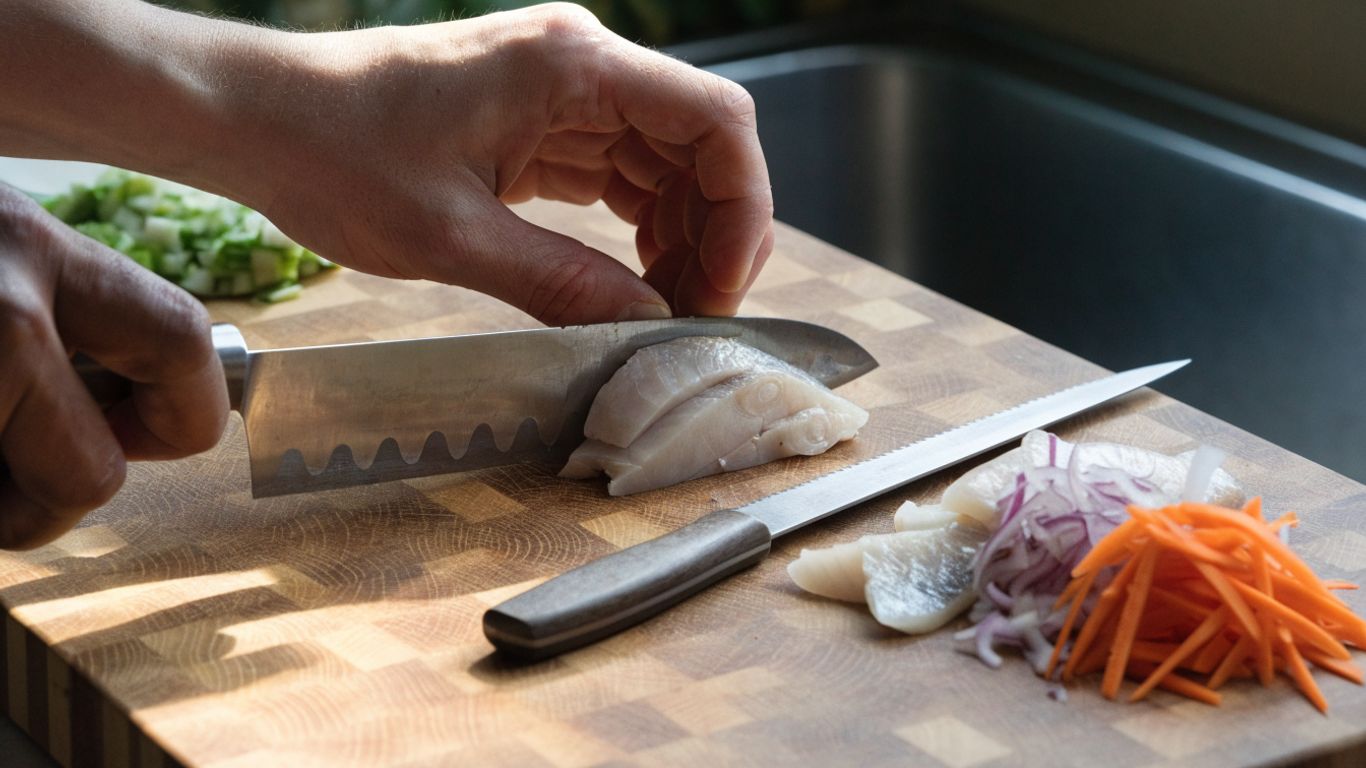
Cutting meat and fish with a santoku
A santoku can handle routine slicing of boneless meat and fish as well as vegetables. Use a clean, controlled stroke and avoid tasks that require a long, flexible fillet blade or cutting through bones. If you prepare raw foods, keep them separate from ready-to-eat ingredients and wash the knife and board between tasks.
Using a nakiri for occasional nonvegetable tasks
A nakiri can sometimes slice soft, boneless foods, but its shape is not intended to replace a more versatile knife for regular protein prep. Its squared end is not designed for trimming around bones or piercing. If your nonvegetable cutting is rare and simple, you may be able to manage it; for frequent mixed prep, a santoku is usually the more practical single choice.
Why neither knife replaces a chef’s knife in every kitchen
A chef’s knife often has a more pronounced point and a different curve, which can suit tasks such as detail trimming and varied rocking cuts. A nakiri and santoku each have their own strengths, but no shape is a universal answer. If you already own a knife that handles your daily work comfortably, a second knife should solve a real gap rather than merely add another name to the drawer.
How do comfort, control, and care compare?
A knife that feels secure in your hand is easier to guide than one chosen only from a description. Try to assess balance, handle shape, and blade length together, since the whole tool moves with every stroke. Care is straightforward: keep the edge maintained, wash by hand, and store the blade so it cannot shift loose in a drawer.
How grip and balance affect control
Hold the handle in a relaxed, secure grip and check whether the blade feels steady when you lift and lower it. Some cooks prefer more weight toward the blade; others want a lighter feel. Grip comfort varies, so there is no useful universal rule that one balance point is best.
Choosing a blade length that fits your board
A long blade can be awkward on a crowded counter, while a shorter blade may require more strokes through a large ingredient. A 17-by-13-inch board is one documented example of a prep surface size: the End-Grain Maple Cutting Board measures 17 by 13 by 1.75 inches and has non-slip feet. The Bevel & Bond End-Grain Maple Cutting Board is about 10 pounds, so consider how you move and store a board as well as how much cutting room it offers.
Sharpening and maintaining each knife
Maintain either knife according to the maker’s guidance, using a sharpening method appropriate for its edge. A straight profile does not eliminate sharpening, and a curved profile does not automatically require a different routine. Keep the blade clean and dry after use, and avoid scraping its edge sideways across the board when moving chopped food.
Safe storage and handling differences
The broad blades of both styles can be easy to see on the board, but they still need careful handling. Set a knife down with the edge directed away from your hand, carry it point-down at your side, and store it in a block, sheath, or secure magnetic holder. The Bevel & Bond End-Grain Maple Cutting Board has a knife-friendly surface, but any board should be kept stable while you work.
How do you choose between a nakiri and a santoku?
For vegetable-centered cooking, a nakiri is the more focused option; for a wider mix of ingredients, a santoku is more versatile. The difference is not a verdict on quality but a question of fit. Think about your usual cutting motion, board space, and the jobs you actually do each week.
Match the knife to what you prep most often
Make the decision from your ordinary meals, not from the most demanding thing you might cook once a year. If most sessions involve chopping produce, the nakiri’s shape fits that routine. If your prep moves from vegetables to boneless protein, the santoku gives you a broader range in one knife.
Consider your preferred cutting motion
If you like to bring the edge straight down or push it through an ingredient, the nakiri’s edge will feel intuitive. If you use a gentle rocking motion as well as push cuts, a santoku may feel more natural. A few deliberate strokes with each style, if you can handle them safely before buying, tell you more than a long list of features.
Factor in kitchen space and budget
A second knife needs a place to live and a reason to be used. Compare the actual dimensions, handle shape, and care requirements of the knives you are considering, then decide whether a specialized vegetable knife adds enough value to your kitchen. Avoid assuming that a particular style always costs more; prices depend on the maker and materials.
A simple decision guide for home cooks
Use your regular prep as the deciding factor: frequent, focused vegetable chopping points toward a nakiri; mixed everyday cutting points toward a santoku. The Bevel & Bond End-Grain Maple Cutting Board is another specific piece of equipment to assess by its documented dimensions and features, not as a reason to choose one knife shape over another. If you are still undecided, start with the motion that feels most controlled and add a specialized knife only if your routine calls for it.
Nakiri or santoku: which to choose
For a kitchen centered on vegetables, the nakiri’s straight edge and chopping-focused shape make a clear match; for a wider mix of vegetables, meat, and fish, a santoku is the more flexible choice. Pick the knife that fits your usual ingredients and comfortable stroke, then keep it sharp, stable, and safely stored.
Best for
- Vegetable-heavy cooking: a nakiri, with its mostly straight edge for push cuts and chops.
- Mixed prep that includes meat and fish: a santoku.
- Cooks who like a light rocking motion: a santoku, with its gently curved edge.
Frequently Asked Questions
Is a nakiri better than a santoku for vegetables?
A nakiri is designed specifically around vegetable prep, and its straight edge suits direct chopping. A santoku also cuts vegetables well and offers more flexibility for other ingredients.
Can a santoku chop vegetables as well as a nakiri?
Yes. Both can chop, slice, and dice vegetables; the edge shape changes how each knife feels during the cut more than what vegetables it can handle.
Can you use a nakiri for meat?
A nakiri may manage occasional cuts of soft, boneless foods, but its shape is not meant for regular mixed-ingredient or bone-in work. A santoku is generally more versatile for routine boneless meat prep.
Is a santoku suitable for fish?
A santoku can slice everyday portions of boneless fish. For filleting or work around bones, a purpose-made knife is a better fit.
Which knife is easier for a beginner?
Neither is automatically easier for everyone. Choose the one that feels secure in your hand and suits the cutting motion you can control comfortably.
Does a nakiri have a sharp point?
Usually not. Many nakiri knives have a squared or blunt tip, reflecting their focus on chopping and slicing vegetables.
Should you buy both a nakiri and a santoku?
Only if each fills a useful role in your cooking. If you want one knife for varied everyday prep, a santoku is the broader choice; if you regularly chop large amounts of vegetables, a nakiri can complement it.
What should you do next?
- List the ingredients you cut most in a normal week.
- Note whether you push cut, chop, or rock the blade.
- Hold both shapes if you can, and pick the one that feels controlled.
- Practice even cuts with knife skills for a more uniform dice.
- If you choose carbon steel, read how to clean and oil a carbon steel knife.