END-GRAIN GUIDES
How to Use a Mezzaluna: A Practical Guide to Chopping Herbs and More
Learn how to use a mezzaluna safely for chopping herbs, garlic, nuts, and coarse mixtures.
The short answer
To learn how to use a mezzaluna, hold both handles and rock the curved blade through a small pile while keeping your fingers clear. It is especially handy for herbs and coarse mixtures; a straight knife gives you more control when you need precise, even pieces.
- Start with a stable board and ingredients that are washed, dried, and trimmed.
- Keep the blade close to the board and use a steady rocking motion.
- Regroup ingredients as needed instead of forcing a large pile under the blade.
- Use short strokes for nuts and other firmer ingredients, and avoid hard or frozen foods.
- Wash and dry the blade carefully, then store it where its edge is protected.
What should you know about your mezzaluna?
A mezzaluna is a curved chopping blade with one or two handles, designed to rock across a cutting surface. The simple motion suits herbs, garlic, and other ingredients you want chopped without much fuss. Its shape takes a little practice, but you can start slowly and build a comfortable rhythm.
How the curved blade and handles work
The curve lets the blade pivot from one side to the other while its edge stays in contact with the board. You hold the handles rather than guiding the blade with your fingers, so both hands can steer the rocking motion from above. Keep the movement small at first; a controlled roll is more useful than speed.
Single-blade and double-blade designs
A single blade is straightforward to clean and leaves fewer places for small pieces to lodge. A double blade can make quick work of a pile, though ingredients may catch between the blades. Use the design comparison below to decide what suits the way you cook.
| Design | What it’s like to use | A practical trade-off |
|---|---|---|
| Single blade | Simple rocking motion through the pile | Easy to check and clear between strokes |
| Double blade | Two parallel edges pass through ingredients | Small pieces can get caught between blades |
| Either design | Handles let you guide the blade from both ends | Needs a clear, stable patch of board |
Neither style removes the need to regroup the food or check the cut. Choose the one that feels easy to control in your hands, then let the blade do the work rather than pressing hard.
What a mezzaluna does better than a chef’s knife
A mezzaluna is convenient when you want to chop a loose pile of herbs or bring several ingredients together into a rough mixture. Its rocking path makes repeated cuts across the pile feel natural. For more about the tool’s common uses, see this mezzaluna chopping guide. A chef’s knife is still the more useful choice when the pieces need straight edges or carefully controlled sizing.
How should you set up your board and ingredients?
A little preparation makes the chopping motion calmer and more predictable. Set the board on a dry, steady counter, then make sure the ingredients are ready before you pick up the blade. A crowded or slippery workspace is no place to practice a new tool.
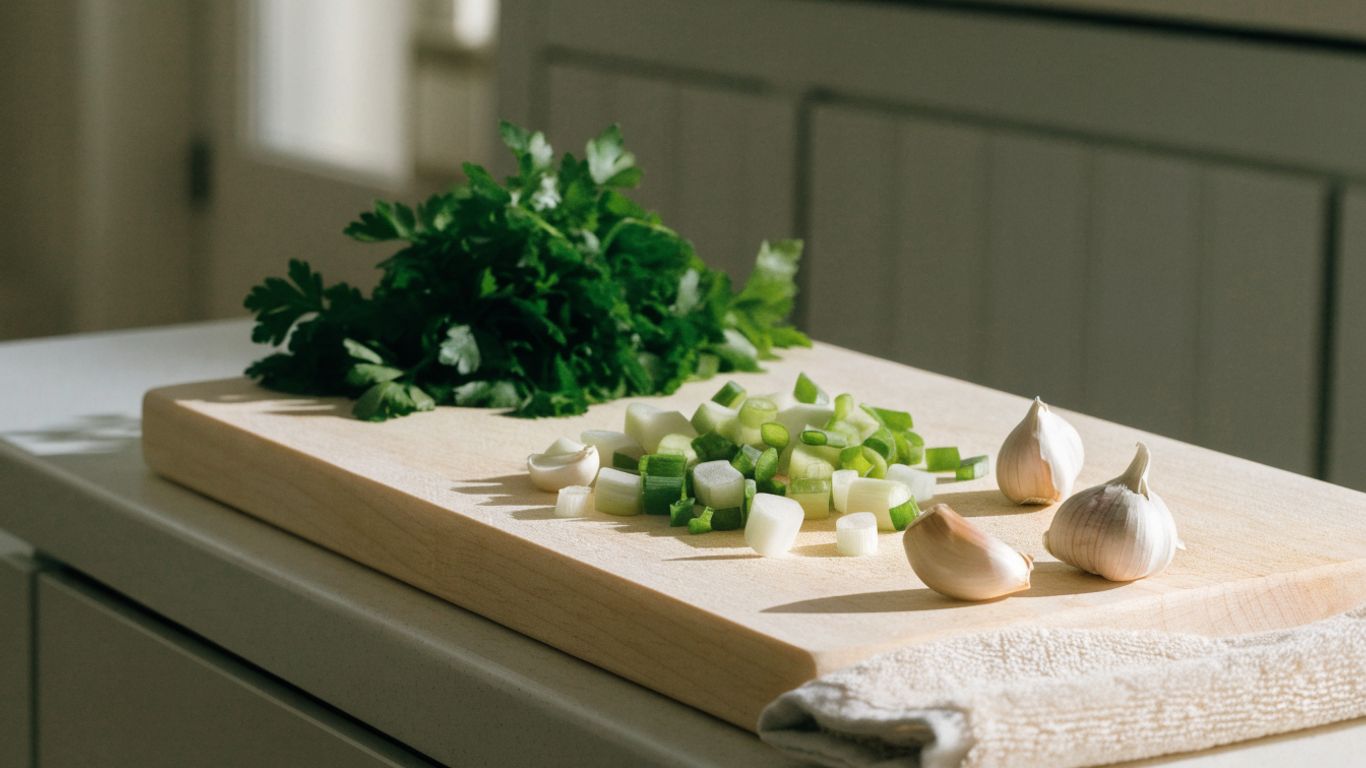
Choose a stable, spacious cutting surface
Use a board that stays put when you press down gently on the handles. Leave room around the ingredient pile so the blade can rock without running into a bowl, counter edge, or other tools. If you want more guidance on work area and sizing, this small-kitchen maple board guide discusses how usable space and storage affect board choice.
Wash, dry, and trim ingredients before chopping
Rinse herbs and vegetables as needed, then dry them well so the pile does not slide around or turn wet and clumpy. Remove tough stems, roots, and damaged leaves before chopping. Smaller, tidy pieces are easier to gather under the blade than long stems or whole, bulky vegetables.
Gather ingredients into a compact pile
A low, compact pile lets the blade pass through the ingredients without scattering them across the board. Keep the pile within the curve of the blade, and leave enough room to rock from side to side. A quick prep sequence helps keep the work area orderly:
- Pull away tough stems, roots, or skins that are not going into the dish.
- Dry washed ingredients with a clean towel.
- Chop oversized pieces into shorter lengths before gathering them.
- Keep a bowl nearby for finished ingredients, not under the blade’s path.
Once the pile is ready, you can focus on the rocking motion instead of chasing stray leaves around the counter. If the pile spreads, pause and gather it again rather than reaching toward the blade while it is moving.
How do you use a safe rocking motion?
The safest approach is a low, controlled rock with both hands on the handles. Keep your fingers on the handles and away from the cutting edge, and work at a pace that lets you see where the blade is landing. You do not need to lift the tool high between cuts.
Hold both handles and keep your fingers clear
Grip one handle in each hand, with your fingers wrapped around the grips rather than extending toward the blade. Position the blade over the middle of the pile before you begin. Keep your hands on the handles throughout each stroke, and stop to reset if your grip or stance feels awkward.
Rock the blade from side to side through the pile
Press one side of the curved blade down, then roll across the pile toward the other side. Let the curve guide the edge along the board instead of chopping straight down from a height. Short, even strokes are easier to control and keep the blade close to the work surface.
Rotate or regroup ingredients for an even chop
After several passes, pieces near the outside may be larger than those in the center. Stop the motion, sweep the ingredients back into a compact mound, and turn the pile if needed. Then make another few passes and check the texture before continuing. This simple reset is more effective than rocking harder over food that has already scattered.
Know when a knife is better for a uniform dice
A mezzaluna produces a chopped or minced texture, not a neat set of cubes. When a recipe depends on evenly sized pieces, use a straight knife and work through a consistent cutting sequence. This even vegetable dice guide can help you think through board stability, grip, and repeatable cuts. Save the mezzaluna for ingredients where a little variation is welcome.
What can you chop with a mezzaluna?
The tool is most at home with small, tender ingredients that benefit from repeated cuts. Start with a modest pile and stop to check the texture as you go. The same rocking action works across several kinds of prep, but the right pace depends on how soft or firm the ingredients are.
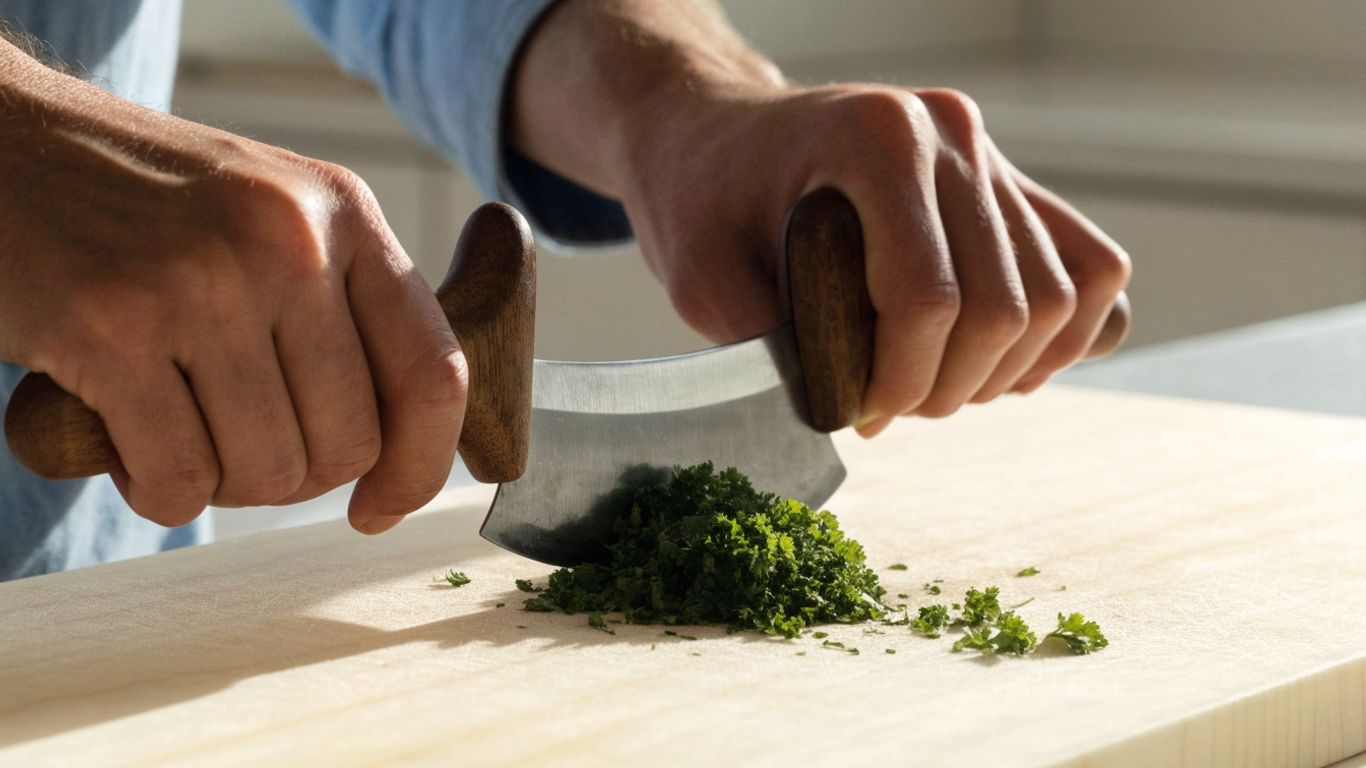
Mince soft herbs without bruising them
Dry the leaves thoroughly and gather them loosely rather than compressing them into a tight ball. Rock the blade through the pile with light, short strokes, then regroup the leaves and check the size. Stop when the herbs are finely chopped enough for the dish; continuing after that can turn a clean mince into a damp mass.
Chop garlic, onions, and tender vegetables
Peel garlic and cut larger cloves or onion pieces into smaller chunks before chopping. This gives the blade a manageable pile and helps avoid large pieces escaping at the edges. Rock through the ingredients, pause to gather them, then continue until the texture suits your recipe. For a more regular dice, switch to a knife instead.
Make pesto, salsa verde, and other coarse mixtures
A mezzaluna works well when you want a chopped mixture that still has some texture. Add the herbs and other prepared ingredients in a pile, then rock through them in several passes. Gather everything together between passes so the ingredients combine without becoming uniformly fine. The finished mixture should look chopped, not pressed into a paste.
Use short strokes for nuts and firmer ingredients
For nuts, begin with a small amount and keep the strokes short. Pause to check for pieces that have rolled away, then gather them back before continuing. This nut-chopping board guide covers board stability and controlled chopping for firmer ingredients. Do not use the mezzaluna on hard or frozen foods; those call for a different tool and method.
What common mistakes should you avoid?
Most problems come from moving too quickly or asking the blade to handle more than it can comfortably reach. Keep the pile small, the motion low, and the cutting area clear. If the ingredients scatter or stick, pause and adjust instead of adding force.
Don’t lift the blade high between strokes
A high lift interrupts the rocking path and makes it harder to keep the edge controlled. Keep the blade close to the board as you shift from one side to the other. If you need to reposition, stop and lift the tool deliberately rather than swinging it over the ingredients.
Don’t overload the blade with a large pile
A thick mound hides the ingredients underneath and makes an even chop harder to judge. Start with enough food to fit comfortably under the curve, then work in batches if you have more. A few extra passes are less aggravating than trying to contain a pile that keeps escaping.
Don’t use the mezzaluna on hard or frozen foods
Hard items can be difficult to control under a curved blade, while frozen food may resist the rocking motion. Set those ingredients aside for a tool and approach suited to them. For ordinary chopping, use ingredients that are ready to cut and keep the blade moving only when your hands are safely on the handles.
Adjust your technique if ingredients stick or scatter
Wet leaves may cling to one another, while round or bulky pieces can roll away from the cutting path. Stop the blade, scrape or gather ingredients with a utensil, and make the pile smaller or drier before you resume. Never reach beneath a moving blade to retrieve a stray piece.
How do you clean and store a mezzaluna?
Clean the blade soon after you finish so bits of herbs and food do not dry onto its surface. Handle the cutting edge with care during washing and drying, then put the tool away where it cannot be bumped or grabbed by the blade. A few deliberate steps make cleanup safer.
Wash the blade carefully after each use
Keep your attention on the edge as you wash, and use a sponge or cloth rather than sweeping a bare hand along the blade. Clean between parallel blades as well if your model has two. Follow the care instructions supplied with the tool, since handle materials and construction can differ.
Dry it fully to prevent rust
Wipe the blade dry as soon as it is clean, including around the handles and any area where moisture can collect. Do not leave it sitting wet in a sink or on the board. A dry blade is ready to store without dampness lingering against the metal.
Store the blade with a guard or in a safe spot
Use a blade guard if one came with the tool. Otherwise, choose a drawer or storage area where the edge will not knock against other utensils and where you can reach the handles without brushing the blade. Put it away only after it is fully dry.
What to remember when you use a mezzaluna
A mezzaluna is easy to use once you let its curved blade rock instead of forcing it like a straight knife. Start with a dry, compact pile, keep both hands on the handles, and pause to regroup ingredients as you go. For precise cubes, pick up a knife; for herbs and coarse mixtures, the mezzaluna has a comfortable rhythm of its own.
Best for
- Simple use and easy cleaning: a single blade.
- Faster passes through a pile: a double blade, if you clear pieces caught between the edges.
- Herbs and coarse mixtures: either mezzaluna design.
- Precise, even pieces: a straight chef’s knife instead.
Frequently Asked Questions
What is a mezzaluna used for?
A mezzaluna is used to chop ingredients such as herbs, garlic, and nuts with a rocking motion. It is especially suited to chopped or minced textures rather than precise cubes.
How do you hold a mezzaluna?
Hold one handle in each hand, keeping your fingers wrapped around the grips and away from the blade. Begin with the edge positioned over the center of a compact pile.
Can you use a mezzaluna for herbs?
Yes. Dry the herbs, remove tough stems, and rock the blade through a small pile in short strokes. Regroup the leaves and check the texture between passes.
Is a single-blade or double-blade mezzaluna easier to use?
Either design can work well. A single blade is simpler to clear, while a double blade can chop through a pile quickly but may catch small pieces between its edges.
Can a mezzaluna make a uniform dice?
It is not the best tool for a uniform dice because its rocking motion produces a chopped texture. Use a straight knife when even cubes matter to the recipe.
Can you chop nuts with a mezzaluna?
You can chop nuts in small batches with short, controlled strokes. Pause to gather pieces that roll away, and do not use the tool on hard or frozen foods.
How should you clean a mezzaluna?
Wash it carefully after use, taking care around the cutting edge and between blades if there are two. Dry it fully and store it with a guard or in a place where the blade is protected.
What should you do next?
- Clear a stable patch of board and set a damp towel underneath.
- Start with a small pile of soft herbs, such as parsley.
- Keep both hands on the handles and your fingers clear of the blade.
- For nuts and chocolate, read an end grain board for chopping nuts and chocolate.
- When you need even pieces, switch to knife skills for a more uniform dice.